
Uncategorized
Guide to Peptide Reconstitution
May
If your dosing is off before the first draw, the rest of the protocol is already working against you. A solid guide to peptide reconstitution matters because accuracy at this stage affects consistency, waste, and confidence in every measured dose that follows.
For serious users running peptide protocols for recovery, body composition, or performance support, reconstitution is not the place to guess. The process is straightforward, but small mistakes stack fast – too much bacteriostatic water, poor sterile handling, or bad concentration math can turn a quality product into an inconsistent setup. If you want reliable prep, cleaner measurements, and less product loss, get the fundamentals locked in.
What peptide reconstitution actually means
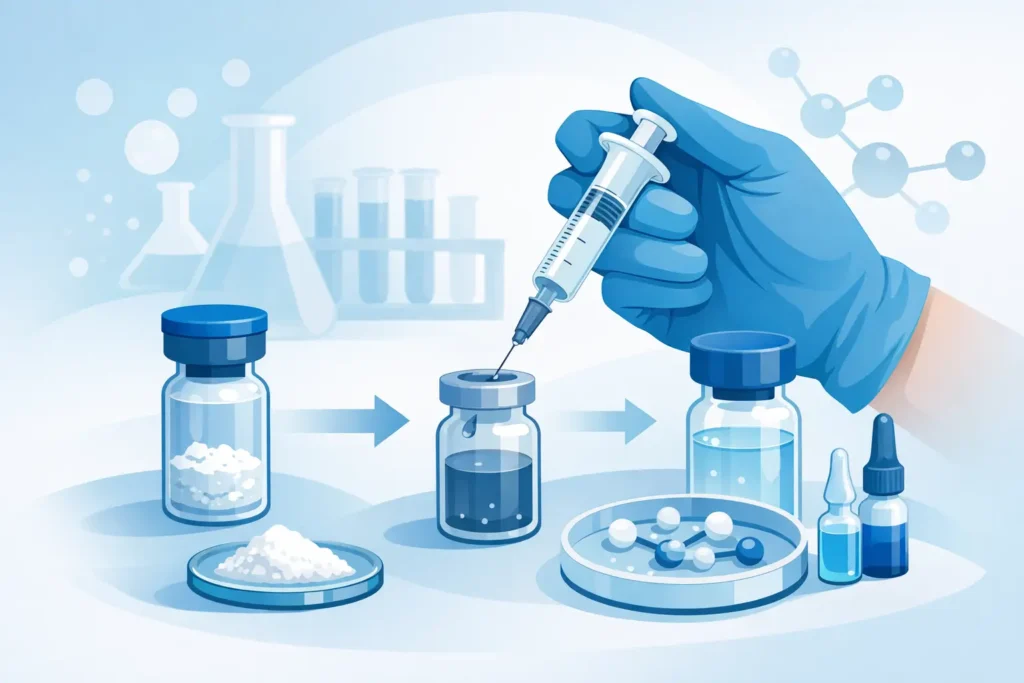
Peptide reconstitution is the process of adding a sterile diluent, most commonly bacteriostatic water, to a lyophilized peptide powder so it can be measured and used in liquid form. Most peptides are shipped as a dry powder because that format improves stability during storage and transit.
Once liquid is added, you are creating a usable concentration. That concentration determines how much volume you draw for each intended dose. This is where many users either simplify the process and get it right, or overcomplicate it and make preventable errors.
The goal is not just to mix powder with water. The goal is to create a concentration that makes your dosing practical. If you have to pull tiny, awkward amounts on every draw, your setup probably is not optimized.
Guide to peptide reconstitution: what you need
You do not need a lab-grade setup, but you do need clean handling and the right supplies. In most cases, that means your lyophilized peptide vial, bacteriostatic water, a sterile syringe, alcohol prep pads, and a clean surface.
Bacteriostatic water is preferred by many users because it contains a preservative that helps reduce bacterial growth after opening. That does not mean careless handling is fine. It means you still treat every step seriously.
Insulin syringes are often used later for measured dosing, but for the initial reconstitution, many users prefer a larger sterile syringe that makes it easier to transfer the exact amount of diluent. If your math is right but your measurement is sloppy, the result is still sloppy.
Start with the vial strength and your target concentration
Before adding any liquid, check the amount of peptide in the vial. Common strengths include 5 mg, 10 mg, and higher depending on the compound. Then decide how concentrated you want the final solution to be.
This is where practical thinking matters. A 5 mg vial can be reconstituted with 1 mL, 2 mL, or another amount depending on the dosing approach you want. Less liquid creates a more concentrated solution. More liquid creates a less concentrated one. Neither is automatically better. It depends on the dose you plan to measure and how precise you want each draw to be.
For example, if a 5 mg vial is mixed with 2 mL of bacteriostatic water, the final concentration is 2.5 mg per mL. If that same vial is mixed with 1 mL, the concentration becomes 5 mg per mL. Same vial, different usability.
Users often choose a dilution that makes the math cleaner on an insulin syringe. That is a smart move because it reduces the chance of repeated calculation errors.
The basic math without the confusion
Reconstitution math gets talked about like it is complicated. It is not. You are taking the total amount of peptide in the vial and dividing it by the total amount of liquid you add.
If your vial contains 10 mg and you add 2 mL of bacteriostatic water, you now have 5 mg per mL. If you add 4 mL instead, you have 2.5 mg per mL.
From there, convert your intended dose into the amount you need to draw. If your concentration is 5 mg per mL and your intended dose is 500 mcg, that equals 0.1 mL. Since 1 mg equals 1000 mcg, the conversion is simple once you slow down and set it up correctly.
The real mistake is rushing. Most dosing problems come from mixing up mg and mcg, or forgetting how much liquid was added after the fact. Write it down immediately. Label the vial if needed. Precision beats memory every time.
How to reconstitute peptides correctly
Clean your hands and prep your surface first. Wipe the tops of both the peptide vial and the bacteriostatic water vial with alcohol. Let them dry before puncturing.
Draw the planned amount of bacteriostatic water into the syringe. Insert the needle into the peptide vial and direct the stream of liquid gently against the inside wall of the vial rather than blasting it directly into the powder. That reduces agitation and helps protect peptide integrity.
After the water is added, do not shake the vial aggressively. Swirl it gently or roll it lightly until the powder dissolves. Some peptides go into solution quickly. Others take longer. Forcing the process with hard shaking is unnecessary and can be counterproductive.
Once fully dissolved, store the reconstituted vial as appropriate for the compound, typically refrigerated unless product-specific handling says otherwise. Consistent cold storage helps protect stability after reconstitution.
Sterile technique is not optional
A good guide to peptide reconstitution has to be blunt here – contamination ruins product quality fast. Every time a vial is punctured, there is an opportunity for bacteria or debris to enter if your handling is careless.
That means wiping stoppers, using sterile needles and syringes, avoiding repeated unnecessary punctures, and keeping the vial sealed and refrigerated between uses. Do not leave reconstituted peptides sitting out on a counter for convenience. Do not reuse needles. Do not assume bacteriostatic water covers poor technique.
For buyers who care about premium-grade sourcing, this should already make sense. Quality starts with the product, but it does not end there. Your handling plays a direct role in what you get out of the vial.
Common mistakes that throw off results
The biggest error is bad dilution math. It sounds basic because it is basic, yet it is still the most common issue. One wrong decimal point can mean underdosing, overdosing, or running out of product earlier than expected.
The next mistake is choosing a concentration that makes dosing harder than it needs to be. If each dose requires an awkward micro-volume, your margin for error gets tighter. Sometimes adding slightly more diluent creates cleaner, more repeatable measurements.
Another problem is rough mixing. Peptides are not a pre-workout powder you slam in a shaker bottle. Gentle handling is the standard. Then there is storage. Heat, light exposure, and repeated temperature swings are avoidable ways to shorten usable life.
Finally, too many users rely on memory instead of labeling. If you reconstitute multiple compounds, write down the vial strength, amount of diluent added, and date mixed. It takes seconds and saves a lot of preventable confusion.
Why concentration choice matters for performance-focused users
If you are using peptides as part of a serious physique, recovery, or body-composition strategy, consistency matters more than theory. A concentration that works well on paper but is annoying in practice creates room for repeated dosing variability.
This is why experienced users often choose reconstitution amounts based on syringe readability and dosing convenience, not just arbitrary numbers. Cleaner measurements support cleaner execution. When your protocol is built around repeatability, the preparation stage should support that goal, not complicate it.
That also means there is no single best dilution for every peptide or every user. A heavier dosing protocol may justify one setup, while a lower-dose protocol may work better with another. It depends on the compound, the target dose, and how precise you can realistically be every single time.
Buying quality is only half the equation
Even premium peptides can be mishandled after delivery. That is the hard truth. COA-backed quality, clean manufacturing language, and strong sourcing standards all matter, but they do not replace accurate reconstitution.
If you are investing in advanced compounds for muscle retention, recovery support, fat-loss protocols, or performance optimization, treat the prep stage like part of the protocol itself. Brands like Alpha Core Peptides serve a market that expects consistency, and that expectation should carry all the way through your handling, math, and storage.
The edge is rarely found in doing dramatic things. More often, it comes from doing the basic things with zero sloppiness. Reconstitute carefully, measure with intent, and keep your setup as precise as the goals you are chasing.
